AI can turn a text prompt into an STL file in minutes, but not every generator produces models worth printing.
Not everyone can model from scratch in Blender. If you have an idea for a 3D printed part, a figurine, or a custom bracket, AI model generators can bridge that gap. These tools accept text prompts, photos, or sketches and output 3D files you can send straight to a slicer. The quality varies. Some produce watertight meshes ready for printing. Others generate geometry that needs repair before it will slice.
Here are the six generators worth knowing about right now, and what they actually do well.
Fast3D
Fast3D is a web app that turns text or images into textured meshes. It offers four quality levels: Fast, Standard, Pro, and Ultra. Free users get Fast and Standard; paid tiers unlock Pro and Ultra. Export formats include GLB, FBX, OBJ, and STL, so you can send files to a slicer or into a game engine. Generation times range from five seconds for simple meshes to three minutes for high-poly models with PBR textures. The free plan uses a CC BY 4.0 license, which requires attribution. Paid plans make assets private and fully commercial.
Hi3D
Hi3D is built specifically for 3D printing, not general asset creation. It generates at 1536 cubed resolution, with a 2048 cubed version 3.0 promised but not yet released. The platform exports OBJ, GLB, STL, FBX, USDZ, and 3MF. Its split-to-print tool automatically divides large models into printable sections and adds mortise-and-tenon or ball-joint connectors. A press-fit tolerance system calculates assembly clearances based on your printer, nozzle size, and material. That is a practical touch few other generators offer.
Pricing runs on credits. The free tier gives 100 lifetime trial credits, roughly seven to ten models. Paid tiers start at $19.90 per month for 1,000 credits.
Meshy
Meshy raised nearly $400 million at a $1.5 billion valuation in July 2026. The platform turns text, photos, and sketches into 3D models without requiring modeling experience. It exports STL and 3MF for printing, plus FBX, OBJ, GLB, USDZ, and BLEND for other workflows. A printability check runs before export and flags thin walls, floaters, holes, and non-manifold edges. Auto Repair fixes broken meshes and inverted normals. The company claims around 97% of figurine-type models pass validation in Bambu Studio.
The 3D Agent feature lets you refine models through conversation rather than restarting from scratch each time. You can ask questions about orientation or print settings without leaving the chat. That makes it useful for makers who want to iterate quickly but do not want to learn CAD.
Neural4D
Neural4D uses a volumetric approach called Spatial Sparse Attention to reconstruct the entire object, not just the visible surface. The result is a closed, watertight mesh with no holes or non-manifold edges. The base mesh generates in about 90 seconds. Adding PBR textures takes another two minutes. Exports include OBJ, FBX, GLB, USDZ, STL, and BLEND. Free users get untextured meshes only; textured downloads require a paid plan.
Rodin
Rodin is developed by Hyper3D and used by companies including Tencent, Bambu Lab, Meta, Nvidia, and Google DeepMind. The current Gen-2.5 model generates base geometry in about four seconds and a full textured model in about five seconds. It supports meshes above 10 million polygons and exports directly to STL, OBJ, FBX, GLB, GLTF, and USDZ. The Business-tier High-Poly Quads option targets quad-based topology, which is easier to clean up or retopologize before printing than the triangulated meshes some generators produce.
Tripo AI
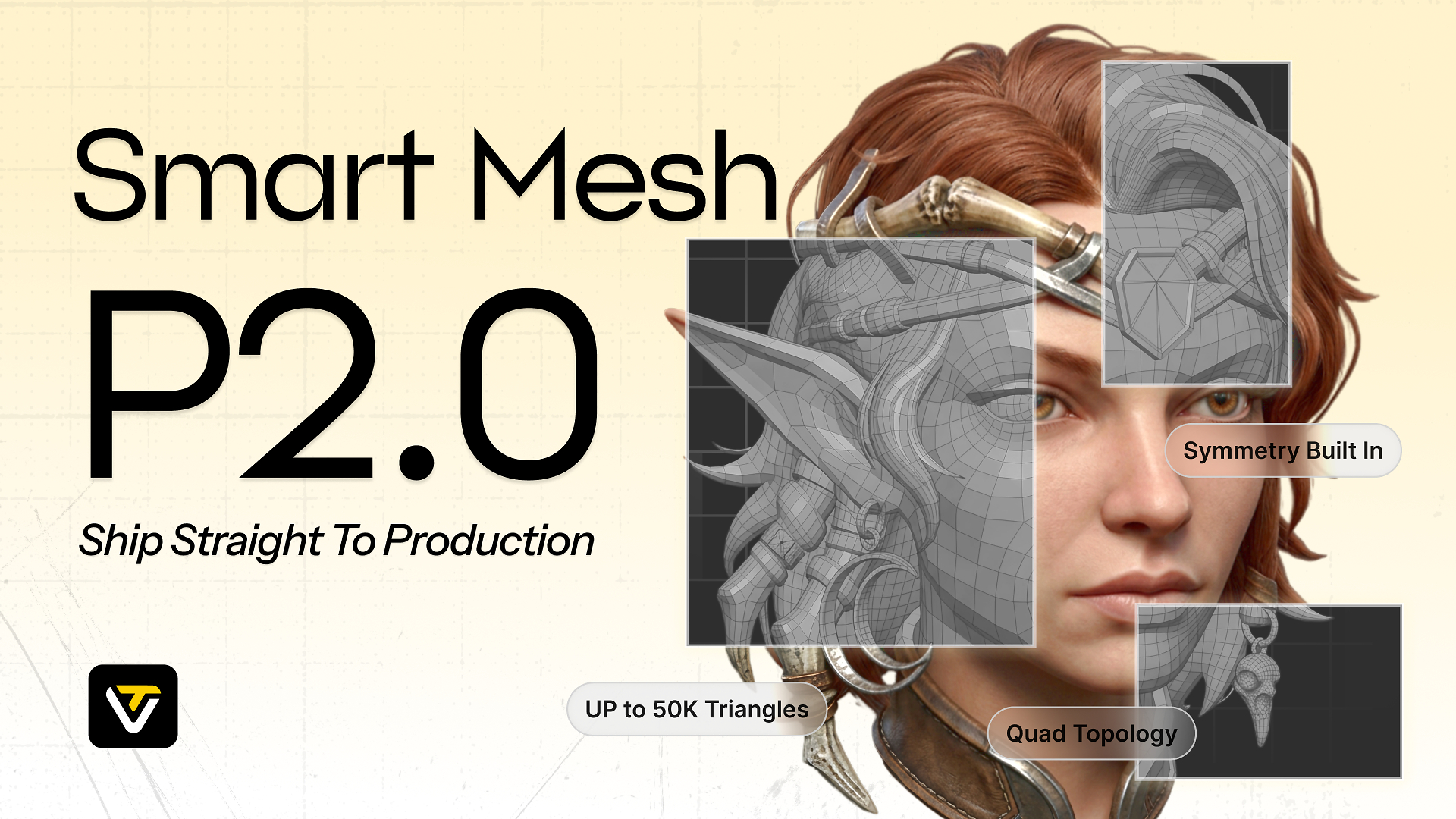
Tripo AI is a foundation model from VAST, with clients including Tencent, NetEase Games, Sony, and Bambu Lab. It generates 4K PBR textures and includes a Magic Brush tool for locally repainting or correcting specific texture areas without regenerating the whole model. Smart Mesh targets cleaner, lower-poly topology when print-readiness matters more than surface detail. Generation time ranges from a few seconds to a few minutes depending on mode and queue priority. Exports include STL, OBJ, FBX, GLB, USD, and 3MF.
What to Expect
AI-generated models are strongest on organic shapes and characters. Parts that need tight tolerances are still better handled in traditional CAD. Features under 1mm can be fragile, and generated dimensions are not exact, so anything that must match a real measurement should be scaled in the slicer. Watertight export is not guaranteed across every tool, but the generators listed here have made it a priority. Before printing any AI-generated file, inspect the mesh for holes or non-manifold edges. Most slicers will flag them.
If you just need a custom figurine, cosplay prop, or replacement part and do not want to learn modeling software, these tools are now good enough to use. If you need precise mechanical interfaces or load-bearing structures, treat the AI output as a starting point and finish it in CAD.


Comments (0)
No comments yet. Be the first!
Leave a Comment