Elegoo's $299 Centauri 2 brings auto bed leveling and a direct-drive extruder to a full-size CoreXY. We put its out-of-box quality to the test.
At $299, the Centauri 2 is Elegoo's most affordable CoreXY yet
For years the rule was simple: you paid over a thousand dollars for a 3D printer that set itself up. Auto bed leveling, runout sensors, and pressure advance were premium features. Elegoo's Centauri 2 breaks that pattern by putting a full-size CoreXY on your bench for $299.
The numbers are respectable for the price. You get a 256 x 256 x 256 mm build volume, a dual-gear direct-drive extruder, and a claimed accuracy of +/-0.1 mm. Connectivity is USB and Wi-Fi, and the bed is a dual-sided flexible spring-steel plate. None of that reads as budget when you line it up against machines that cost three times as much a couple of years ago.
Out of the box, no tuning required
The most interesting test is the one nobody plans. Reviewer Patrick Campanale loaded SUNLU PLA+ 2.0 onto the standard Elegoo PLA profile, ran the automatic calibration, and printed a detailed Batman pen holder with tree supports. No filament tuning, no flow adjustments, nothing beyond the first-run setup.
It worked. The supports snapped off as cleanly as on a Bambu Lab P1S, and the layer lines on the cowl came out smooth. For a $299 machine that had never been touched beyond factory calibration, that is the result you want.
How it stacks up against the $200 to $300 field
The Centauri 2 lands in a crowded band. The Bambu Lab A1 mini sits at $219 with a smaller plate, the full-size Bambu A1 at $299, and the FlashForge AD5X brings four-color printing for $349. Elegoo's edge is the full build volume and direct-drive extruder at the lowest price of the full-size options.
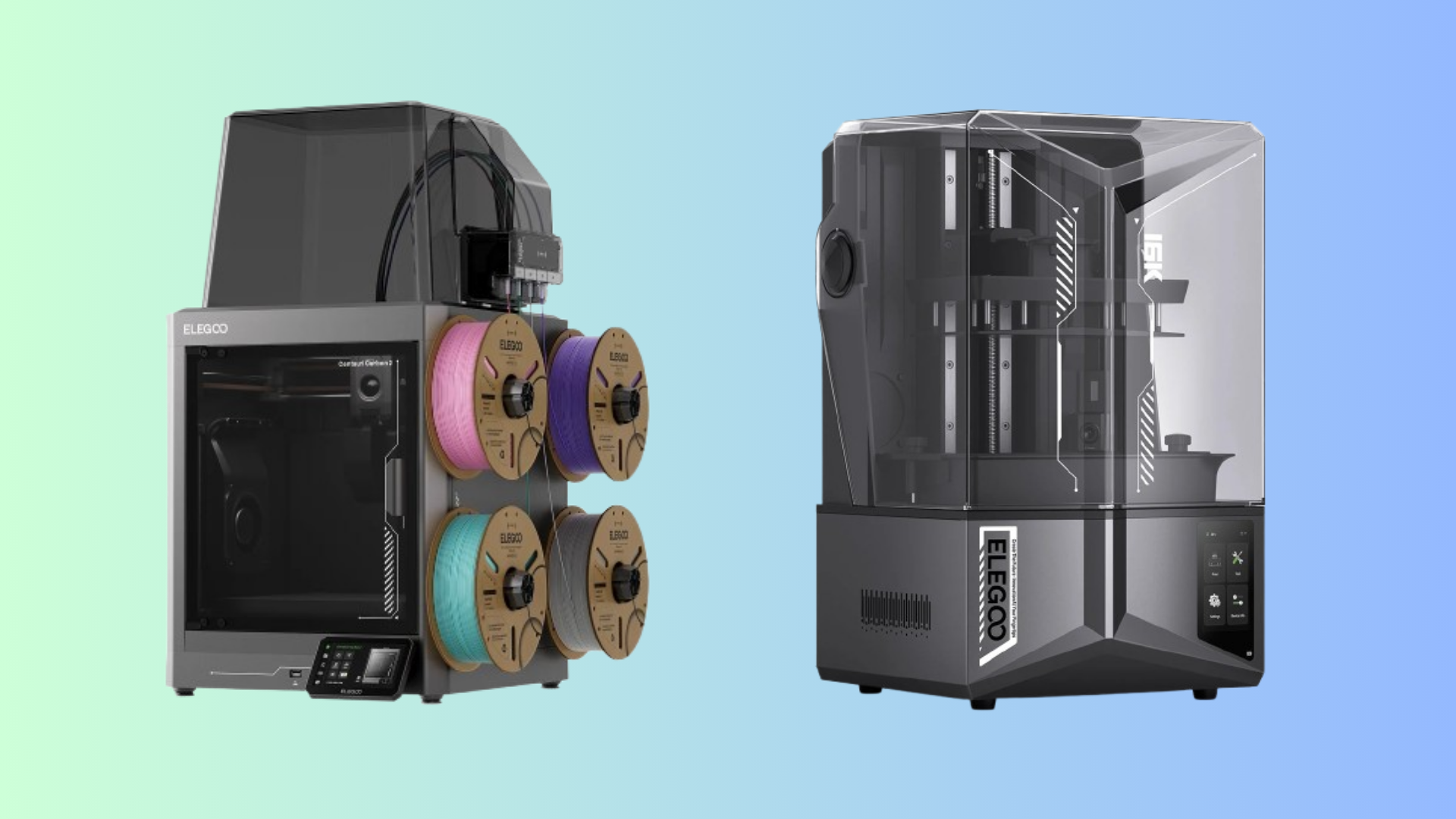
Elegoo also sells a Centauri 2 Combo that adds the multi-material system. The plain Centauri 2 keeps the same speed, nozzle temperature, and bed temperature while dropping the extra hardware to hit $299.
Pros and cons
- Pros: Full-size CoreXY at $299, direct-drive extruder, auto leveling and runout detection, clean support removal out of the box.
- Cons: No enclosed build, multi-material costs extra on the Combo, and a little pressure-advance tuning would likely push speed and quality further.
First impressions
This is an early hands-on, not a final verdict. Even so, the Centauri 2 makes a strong case that the budget tier has caught up to what used to be mid-range. If you have been waiting to start 3D printing until you could afford a real machine, the wait is over.
Comments (0)
No comments yet. Be the first!
Leave a Comment